Labels

value investing (21) Keppel (12) Yangzijiang (11) property (9) HPH (6) REIT (6) Macro economy (4) ST Engineering (4) Starhub (4) Apple (3) OSIM (3) RafflesMG (3) SPH (3) Banking (2) Insurance (2) NamCheong (2) Noble (2) OCBC (2) Oil (2) SMRT (2) SingPost (2) Soup Restaurant (2) VICOM (2) AIMSAMPReit (1) Alibaba (1) BYD (1) CMT (1) CambridgeReit (1) China Life (1) Citibank (1) ComfortDelgro (1) Commodity (1) Conglomerate (1) DBS (1) Dairy Farm (1) Electric Car (1) First REIT (1) GE (1) Gambling (1) Genting (1) Golden Agri (1) HockLianSeng (1) Huabao (1) ICBC (1) Internet (1) Jardine C&C (1) JardineCC (1) KingWan (1) KingsmanC (1) Lenovo (1) Loan (1) M1 (1) Marco Polo (1) Market (1) New Energy (1) OverseasEducation (1) Pharmacy (1) QAF (1) Retirement (1) SP AusNet (1) Sabana (1) SembMar (1) SerialSystem (1) Sound Global (1) Straco (1) Suntec (1) Telecom (1) Utility (1) Wilmar (1) Yongnam (1) sats (1)

Search my blog ...

Loading
Showing posts with label Yangzijiang. Show all posts

Thursday, April 17, 2014

Order enough till 2016, 5 segment strategy


Work on these contracts will fill our yard capacity until 2016. The Group’s strong order book momentum does not reflect the state of the shipbuilding industry, which continues to be challenged by weak demand and excess shipbuilding capacity. We have strong order flow because ship owners choose to place orders with stronger shipyards with a reputation for timely delivery.

In 2013, the Group re-organized and streamlined its business operations into five main segments: 1) Shipbuilding and Offshore, 2) Financial Investments, 3) Shipping Logistics and Chartering, 4) Ship Demolition, Steel Fabrication and related trading businesses, and 5) Property Development.

What we want is to develop each segment into self-sustained units that create synergies for each other. We envisage non-core segments contributing 40% to Group revenue, while the contribution from Shipbuilding and Offshore Engineering will be about 60% in the long run.

Saturday, March 15, 2014

Yangzijiang maintain margin 33%

GS report

YZJ also secured US$260mn new orders YTD (attractive down-payment terms of 55% for some), with US$830mn options outstanding. Looking ahead, YZJ expects: (i) US$2bn of new shipbuilding orders (GSe: US$2.3bn); (ii) to focus on niche mid-water floaters given the lower competition, but no given orders guidance (GSe: US$400mn); (iii) 2014 shipbuilding gross margins of 15-20%, but likely higher end (GSe: 18%); (iv) RMB720mn relocation fees to be paid by the government in 2014 for their old yard.
Expect to maintain 30% payout.

DBS research
2.7 times book-to-bill ratio

Wednesday, January 1, 2014

China surpasses S'pore as global market leader in building rigs

link
In 2013, Singapore secured 26 per cent of all contracts awarded to build drilling rigs - lower than 33 per cent in 2012.
But as Singapore rigbuilders continue to maintain their technological advantage and a strong track record of on-time delivery, some analysts remain upbeat about their prospects.
"So revenue is quite strong but margins are down year-on-year for Singapore, and that is why earnings growth did not come through. It won't be so much of a shock in revenue, but we could see some disappointment in the margins."
Wong Kok Seng, managing director (offshore) of Keppel Offshore & Marine, said: "We are a designer and user as well. So we are able to look at it and construct it in the most cost effective way. We have volume and volume does help with the economy of scale."
OCBC Investment Research notes that Singapore rigbuilders should go into 2014 with record order books - Keppel Corp at $16.1 billion and SembMarine at $13.5 billion - keeping them fully occupied until 2019.

Saturday, November 9, 2013

Yangzijiang 2013 order 2 bln

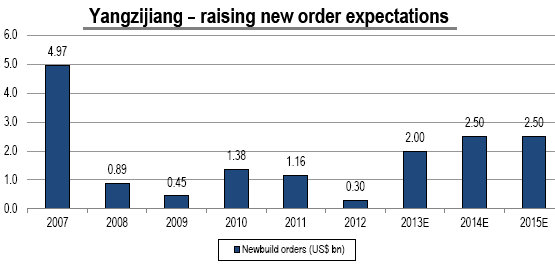
“Yangzijiang has secured 1.22 bln usd of contracts year-to-date, on track to meet our forecast of 2.0 billion in 2013E and with improving order momentum, we raise our 2014E new order forecast to 2.5 billion usd (from 2 billion),” Credit Suisse said.


Friday, April 26, 2013

扬子江船厂控股的盈利下滑29.5%;迄今为止取得共6亿美元订单


扬子江船厂控股的盈利下滑29.5%;迄今为止取得共6亿美元订单
扬子江船厂控股(Yangzijiang Shipbuilding (Holdings))报其截至2013年3月31日的首季盈利从10亿人民币下跌至7亿1,720万人民币,年比跌幅为29.5%。收入从37亿人民币年比下滑22.2%至29亿人民币,主因是公司的核心收入来源造船部门带来的贡献减低。毛利率提高至36.1%,因为投资部门的表现改善。公司的执行主席任元林说:“造船业陷入衰退已有一段时间了,我们认为这个情况已跌至谷底,原因是业内最近出现了活动恢复的迹象。因此,我们一直都在积极地与感兴趣的船主接洽,希望能在近期内为集团赢得新订单。”包括迄今为止取得的新订单(共5亿9,710万美元)在内,公司截至2013年4月26日所需完成的造船订单为33亿美元,造船数量为65艘。
启示:尽管营运环境艰难,公司仍维持26%的造船毛利率,与1Q12一样。公司的财务状况依然稳固,其所持有的现金为81亿人民币,净负债比为偏低的4.9%。

Yangzijiang: 1Q13 results below estimates, margin maintain

Yangzijiang: 1Q13 results below estimates; Revenues declined 22% y/y to Rmb2.87b, together with a 30% decline in earnings to Rmb717.2m; Gross profit margin improved to 36% because of improved performance of investment segment; shipbuilding-related segment margins maintained at 26%. Financial Investment segment bolstered group’s revenues vs its decline in shipbuilding-related segment amid industry downturn. YZJ continues its focus to becoming an integrated marine service provider, focusing on building up its supplementary revenue streams in Financial Investments, Property Development and Shipping Logistics. Mgmt says shipbuilding industry may have hit the trough, and recently seen signs of renewed activity. Current order book of US$3.3b; total contracts orders year-to-date of $US600m.

1Q13 core EPS is 18% above our expectation, at 30% of our FY13 and 26% of consensus, thanks to higher-than-expected shipbuilding revenue and margins. We raise our FY13-14 EPS by 3-16% for higher margins and orders. Upgrade to Neutral from Underperform in view of its better outlook this year with a higher target price at 1.2x, its last trough (previously 30% discount to last trough).

Sunday, April 21, 2013

Jack-up rigs: Chinese make presence felt


Lynn Kan
The Business Times
Wednesday, Apr 17, 2013

SINGAPORE - First Dalian Shipbuilding, now China Rongsheng Heavy Industries.

This year could be remembered as when Chinese shipbuilders-turned-offshore builders sealed more jack-up rig deals than Singapore's Keppel Corporation and Sembcorp Marine, the de facto hegemons in jack-up rigs that had a hand in building 70 per cent of the existing global fleet.

A report by Religare Capital showed that Chinese yards have won US$2.73 billion in jack-up rigs, while the Singapore duo hauled in only US$1.97 billion to-date.

"There's a substantial glut in shipbuilding capacity in China and the yards aren't getting orders so they're making a push into offshore," said Religare Capital analyst Vincent Fernando.

"Since 2006, Chinese shipyards have started to grow their market share, moving up the learning curve and delivering on new projects," said Barclays Research analysts Scott Darling and Clement Chen in a recent report.

Chinese yards are not the only ones that covet pole position. Other shipbuilder-turned-rig builders in Korea like Hyundai Heavy Industries, Samsung Heavy Industries and Daewoo Shipbuilding & Marine Engineering have been busy too, securing orders for drillships that operate in ultradeepwater.

The stand-off between the Singapore rigbuilders and others from China and Korea has been brewing for some years, since shipping entered a slump.

But the moment for capturing more market share is now.

The aged global rig fleet is in need of replacement as consumption for energy increases in emerging economies. Of the world's 500 jack-up rigs, about 300 are over 30 years old.

A new jack-up rig could set back a drilling operator or national oil company by about US$200 million at current prices. And now, their choices are not confined to the top five yards in Singapore or Korea any longer: China yards like Cosco, CIMC Raffles, and Dalian Shipbuilding have entered the picture.

Barclays estimates that, In the past decade, Chinese yards have grown their market share of rigs from 5 per cent to about 30 per cent currently.

And it could increase further. Religare Capital surmised that Chinese yards will be capable of rivalling Singapore yards in terms of rig production capacity by 2015.

The Barclays projections corroborate that: China yards may capture 10 percentage points more of market share in the next two years.

While the perception is that Chinese yards stick to less complex and commoditised jack-up rigs, and are not competing head-on with the likes of Keppel and Sembmarine, that has proven to be increasingly untrue.

"CIMC Raffles in early January won orders for two high spec deepwater semisubmersibles from (Cyprus-based) Frigstad Offshore. These rigs are more advanced than most being built in Singapore right now," said Mr Fernando.

The dealbreaker was more attractive contract terms offered by Chinese yards, he added.

State backing has meant Chinese yards often offer discounts between 10-20 per cent off contract prices and extremely attractive payment terms of a one cent downpayment upfront and 99 per cent of the contract value upon delivery.

In contrast, Singapore yards have a milestone payment system or a 20 per cent-80 per cent payment structure.

But CIMB stands by their belief that the Chinese financier-builder model will not deprive Singapore yards of their fair share of order wins.

"Traditional drillers with stronger cash flows should still find comfort in Singapore and Korean yards, unwilling to take on risks in quality and delivery," said CIMB.

Yet, the aggression shown by Chinese yards has led to a drop-off in operating margins of rig projects, reported Keppel Corp and Sembmarine last year.

Gone were the boom eras of margins that could go as high as 20 per cent. Instead, going forward, management for both companies are keeping to more modest ranges of between 10 and 13 per cent.

"For yards in general - whether in Singapore or China - they will see a weakening in pricing power because they're competing against each other for business," said Mr Fernando.

For now, Singapore yards have articulated clearly that their competitiveness hinges on a mixture of productivity gains and innovation.

"We recognise that there is increased competition in the rigbuilding sphere but we are confident that Keppel Offshore & Marine is able to distance itself through innovation, technology and experience," COO of Keppel Offshore and Marine, Chow Yew Yuen told BT.

Keppel has pursued a strategy of "Near Market, Near Customer", setting up overseas yards in markets like the US, Brazil and China to tap on interest from oil and gas regions around the world and to meet local content demands, said Mr Chow.

And Sembmarine will be shifting from its Jurong premises to a new Tuas Integrated Yard later this year. The new space is configured to minimise the movement of manpower and materials.

This year, Yangzijiang chairman Ren Yuanlin told BT that one way for Singapore yards to keep their edge over Chinese yards is to partner with them.

Know-how is Singapore's strong suit while China has labour, a resource Singapore has sore demand for.

Yangzijiang itself pursued this strategy in 2010 when it bought over Baker Technology's 15 per cent stake in Sembmarine rigbuilding subsidiary PPL Shipyard, sharing board seats with Sembmarine.

However, the investment turned into a litigious affair, that is now before the Court of Appeal, belying Singapore yards' discomfort to relinquish its intellectual property and knowhow easily to overseas competitors.

Setting aside the issue of PPL Shipyard, Mr Ren said collaboration still makes sense to Singapore yards. "The problem is whether there is mindset and willingness to do it. But if Singapore yards want to keep their number one spot, they have to consider ways of collaboration with Chinese yards," said Mr Ren.

http://business.asiaone.com/news/jack-ri...sence-felt

Saturday, April 13, 2013

Yangzijiang

Yangzijiang: In its latest annual report, grp note that YZJ was the most profitable shipyard in China last yr, and the 7th most profitable in the world. This was FORTIFIED BY MULTIPLE INCOME STREAMS, and to mitigate the cyclical nature of core shipbuilding business, grp’s long-term strategy to generate about 60% of revenue from construction of marine vessels and the remaining 40% from related activities such as the offshore sector, ship demolition and other nonshipbuilding activities. Beyond shipbuilding and its related activities, grp has developed supplementary income streams from conservatively managed businesses such as low-risk financial investments. Also leveraged on strong balance sheet to assist ship owners in ship finance and lease vessels for income. Grp currently manage more than Rmb 11b of financial assets that are over and above its Rmb 2b cash reserve, which is held for working capital, expansion and dividend payment needs. Having supplementary income streams puts grp in the favorable position of being able to be selective on shipbuilding contracts during downturns. That means need not enter contracts on compromised terms and conditions. For 2013, grp expect the shipbuilding environment to remain difficult and intend to deliver 42 vessels in 2013, which is lower than the 51 vessels we had in 2012. 2013 product mix will comprise more of large containerships of higher value. The poor shipbuilding market has proven to be an opportunity for grp to become more client-oriented and competitive and will focus on developing vessels that meet ship-owners’ needs and focus on large vessels, for which there is greater demand. Also believe PRC yards will eventually capture a larger share of targeted offshore market because of the nation’s competitive cost structure compared to yards in Korea, Japan or Europe.

Yangzijiang

S&P notes that operators finding it harder to raise capital for new ships, refinance existing loans; shipping defaults will increase in the next few quarters after charter rates for the merchant fleet plunged and banks imposed tougher lending conditions. Rates for vessels have slumped to between 30% and 80% below their 10-year average, as rising fuel costs are curbing earnings and ships ordered during the industry’s boom years are joining the fleet at a time when global trade is subdued; market conditions are lowering the value of assets and discouraging lending. S&P expect asset values and the performance and credit quality of shipping companies to remain weak. Since the credit crisis, orders to build new ships have plunged. Contracts for new vessels halved to $84.7b in 2012, compared with $174.7b in 2008.

Friday, February 15, 2013

Yangzijiang

source
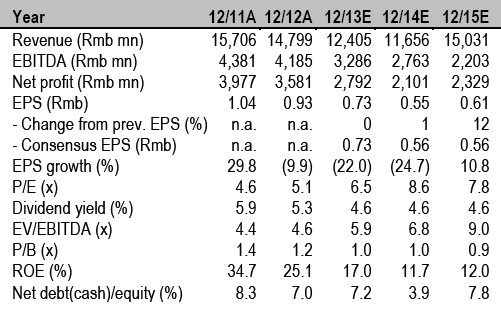
Yangzijiang: Acquired remaining equity interest in 2 subsidiaries, Rmb6m for 40% remaining in Shanghai Henggao Ships Design and Rmb112m for 20% additional Jiangsu Yangzi Xinfu Shipbuilding (bringing aggregate to 80% equity interest). Shanghai Henggao Ships Design is engaged in the detail and production design for a wide range of merchant ships. Jiangsu Yangzi Xinfu Shipbuilding is engaged in shipbuilding, ship repairing, and production and processing of large scale steel structures. Xinfu Yard currently has a shipbuilding license with a huge production area of about 166 hectares, ideal for building large vessels and the Group has plans for building very-large crude carrier (VLCC) or large containership and other larger vessel types in this yard. Mgmt's intention would be for the building of larger vessels and offshore vessels, which will be able to generate better return for shareholders. Company currently trading at 4.9x P/E, 1.3x P/B. Chinese peer Cosco Corp is trading at 17.3x P/E, 1.7x P/B.

Sunday, January 27, 2013

Yangzijiang


Yangzijiang: Secured US$360m contract from Seaspan for 4 additional 10,000 TEU container vessels. The 4, including the 7 ordered since Jun 11, will all be delivered from 2014. YZJ currently has a net cash and financial assets position of Rmb9.95b. With no details of the contract prices provided, DB believe they should come in below the June 2011 contracts with Seaspan for similar 10k TEU ships at US$100m each.

Since mid-2011, ship prices have declined on average by about 11.3%. Overall, commercial vessel new order outlook appears weak in light of industry oversupply and weak credit conditions.

In 2012, YZJ secured a total of only US$300m worth of commercial vessel orders. DB remain cautious on the overall Chinese shipbuilding industry. DB has a HOLD rating with a TP of $1.10 for YZJ.